Since the beginning of the times until now the chiefs of tribes, monarchs, feudal lords, statesmen and politicians decided the mode of production and the distribution of wealth in all the societies.
The main economic influence has been of the governments and not of the private producers, the farmers, fishermen, craftsmen, industrials, traders nor entrepreneurs. They have played a second place because all them has been controlled by the governments, through laws and administrative decisions.
So that it is a historic lie of the Marxist philosophy assuring that the mode of production and distribution of wealth determine the political and social regime of the society; on the contrary, the politics determine the economic and social system of the society. In consequence, may be assured that the laws of market (supply and demand) have not dominated the economy of the countries. The true is that was the monarchs and now the politicians whose decide the limits of the economy and until where the economics concepts are applicable or not. Moreover, they have decided ever something essential in all the historic stages: the fiscal (tax) and commercial policies. At difference of the laws of the science, the laws of the economy are relative and are linked to the social behavior of the big human groups.
It is obvious that the monarchs and politicians has not been isolated and non permeable people; they are too human beings and like the rest of the people they receive the influence of the social media, the custom and the economic institutions of the society. But, in the reality, they have accumulated the true power; that power, in turn, has been supported in the most important of all the powers: the weapons.
In all the times the common citizens has understood this reality and in the most of the cases they have accepted the authority of whose exert the political power; when this not happened occurred the great revolutions.
The modern world knew two great revolutions: the French Revolution (1789) and the Bolchevique Revolution (1917); they changed the course of history. The first led to the born of a new social class, the bourgeoisie; this class was dominated by many years by the monarchs and the feudal lords but in 1789 the bourgeoisie took the power and began to govern a part of the world. This political revolution was, at the same time, a consequence of other important historic fact: the First Industrial Revolution that began at the middle of the eighteen century with the development of the industrial scale of production and the modern machines.
The effects of the French Revolution are still present in the world; they are the abolition of the monarchy in France and other countries, the creation of the Bourgeois Liberal State that encompasses the representative democracy and the capitalist system of free market.
In 1776, thirteen years before the French Revolution, appeared in London the first edition of the book an Inquiry into the Nature and Causes of the Wealth of Nations of the philosopher Adam Smith; this book would be the economic bible of the new bourgeoisie class.
The second one, the Bolchevique Revolution, destroyed the Russia’s monarch’s power, imposed also a new class ---the proletarian class--- and the communist government in a very important part of the world: Russia, Eastern Europe, China, North Vietnam and North Korea.
The communism received their inspiration from the opposed thesis of the Wealth of Nations of Adam Smith. The new theory was presented in the book The Capital of the philosopher Karl Marx, in the year 1867, ninety one years after the first edition of the Wealth of Nations. The Capital became the new economic bible of the communists.
The effects of the Bolchevique Revolution are also still visible; these are the communist regimes that yet survive in some nations. The Communism demonstrated that is not sustainable in the time and for that reason disappeared in the Former Soviet Union and in Europe in the year 1989.
The capitalist system has passed also by serious and recurrent crisis; in the 20th century the most severe was the Great Depression of 1929 and now, in the 21st century, the international financial system fall in the years 2008 and 2009.
The indifference of the statesmen
It provoked those great economic crises. The lack of control on the financial system was one of the main causes of the economy fallout.
Until where the State must exert control over the economy is an old economic discussion.
The State has had ever the faculty of deciding the essential affairs of the economy but in some moments and circumstances the leaders of the governments has resigned to that prerogative. This caused the big economics problems.
It must have a balance between the State and the market, without this balance neither the economic development nor the business is possible.
In the last decades of the 20th century the monetarist thesis reborn promoted by Milton Friedman and his pupils of the School of Chicago. The principal idea of this conception is the absolute free market, this mean, the non intervention of the State in the economics affairs.
As it is obvious, because of practice and legal restrictions, the thesis of absolute free market was not possible of to apply in all their intensity, but she influenced the political action in some countries, especially in Great Britain and in the United States since the governments of Margaret Thatcher and Ronald Regan until the recent government of George Bush Jr.
As consequence of the most recent financial fallout (2008-2009), the authorities have tried of exert a major control on the economy and especially over the financial system; on January 3 2010 in Atlanta, the Federal Reserve chief, Ben Bernanke, declared that “…Regulation must be the first line of defense against speculation…” But the lobbyists of the free market have a great power and influence. They got the bailout for the banks without restrictions. Essential industries, like the automaker and the common citizens did not have the same luck.
The global crisis seems to be permanent. In the last days have appeared the financial problems of Greek and probably Spain, situation that might have an important effect over all the Euro Zone.
Meanwhile, the jobless, the poverty and the environment problem everyday affects a major number of people in the entire world, including the developed industrial nations.
Which will be the future? What do you think?
martes, 16 de febrero de 2010


lunes, 8 de febrero de 2010
The political economy may contribute to build a better world, reflection on the evolution
Abandoned by the politicians and economists of the 20th century, the political economy necessary will reappear in the 21st century, because of a simple reason: man can hide the true, do not recognize it, but this not change the true; and the true is that the political economy is the most important of the social sciences because it synthesize the two most important activities that determine the live of the human beings. The politics alone is not sufficient; the economy alone neither. The combination of both is the base of the power and government an all the societies.
The political economy was abandoned at the begin of the 20th century because she could not respond to the main economical challenges of that moment, among them the economic cycle, the inflation, the devaluation of the currencies, the poverty and the growing unemployment.
Alfred Marshall (1842-1924) separated the economy of the politics and tried of creating an autonomous discipline; he did it and since then emerged the economics as an independent study. The new economics focused their attention in the microeconomics and the econometrics among other issues.
Marshall had interest in the human side of the economy and in contrast with the previous classical economists he asserted that was possible better conditions of live for the working classes. Marshall had a strong social sense and assured that the principal task of the economics should be to eliminate the poverty.
But the new economy promoted by Alfred Marshall and his pupils could neither resolve the accumulated problems. It was John Maynard Keynes, a traditional economist, former pupil of Marshall, which developed the politics and economic new system that gave to the world a partial solution for the economics problems of that historic stage. That new system was the macroeconomics, an integral political proposal that considered the increase of salaries and the private and public expenditure as the key factor for attacking the jobless and the economic recession. The thesis of Keynes was contrary to the ideas sustained by the Classical Economy, which thought that the reduction of salaries was the way for reactivating the employment and the economic growth.
The conception of Keynes let the recovery of the hit economies of the post war. For that reason the thirty years of growth between 1945 and 1975 was named the Age of Keynes. That period was very favorable for the developed nations of America and Western Europe but not for the rest of the world; in those years and the followings (80 and 90) the gap between the rich and the poor nations registered a great difference. The Capitalism generated an important progress but limited only to a small number of countries.
The Communist regimes of the past and of the present, like the Former Soviet Union and the nations of the Eastern of Europe, China, North Korea and Vietnam neither reached an economic welfare; on the contrary, they were and they are impoverished countries.
The first conclusion in this sense is that none of the economics systems has been able of to improve the quality of live of the majority of the world population so far.
Origin of the wealth and the poverty
The first form of property was the community property. The primitive man did not know the private property. It was the appropriation of the first lands by the stronger men the cause of the original richness; this was too the first economic sin. The consequence of this process was the born of two classes: the owners and the exploited, this means the rich and the poor.
A reflection on the evolution
The concept of evolution deserves an especial consideration. Man of the 21st century has the same predatory attitude of the primitive man. He commits murders, abductions, cheatings and stealing, terrorist acts against innocent people, maintain the slavery and do the war.
In parallel also exists the contrary: goodness, kindness, justice, love, religiosity and peace; the great problem is that in the majority of the societies this is not the common. This lead to an unavoidable question: until what the human being has evolved?
Man has achieved a great level of development since the scientist and technological point of view but not in his social and economic behavior.
In the 21st century exist the same social and economics conflicts of the Prehistory, it means:
a) The struggle by the property of the land: a minority is the owner of the majority of the urban and agricultural lands in the entire world.
b) The majority of the workers worldwide receives an insignificant salary that do not let them neither to buy the essential food.
c) The unemployment and sub employment affects the most of the workers worldwide.
d) The economics and social conditions of the work in the most part of the underdeveloped countries are in the practice conditions of slavery.
e) The struggle by the wealth distribution benefits to the privileged rich classes.
A new conflict has emerged
But a new conflict ---unknown in the past--- has arisen in the beginning of the 21st century: the global shortages of basic natural resources ---as water and petroleum--- that change the economic paradigm. The shortage of natural resources is a consequence of the overexploitation of the resources and of the pollution. The outcome is the scarcity of manufactured goods and more inflation.
A look to the past
The evolution of the humanity is divided in two great stages: the Prehistory and the History; the first is the period previous to the invention of the writing and the second begin since that moment until the present.
In the Prehistory man built the basic elements of the progress: constructed the first instruments of stone, learned how to transform the matter through the fire and discovered the agriculture, the ceramic, the metals, the road, the tools, the architecture, the textile, among other great advances.
At the beginning of the history in successive stages developed the writing and after created the print, an instrument that changed completely the history.
The other great historic jump occurs in the 18th century: the creation of the machine of vapor and of a new scale of production developed during the First Industrial Revolution in Europe.
In the 19th century appears in the scene the Second Industrial Revolution; this was the revolution of the energy and emerged two inputs ---the petroleum and the steel--- that joined to the electricity modified completely the live of millions of people.
In the 20th century the progress of the chemical and the medicine and the creation of the mass media represented the other great changes of the history. In this century happened, moreover, two extraordinary facts: the discovery of the nuclear energy and the conquer of the space.
All the mentioned advances suppose a great dominium of the exact sciences, the mathematics, physics, chemical, biology, medicine and the astronomy.
Man do not dominate the social sciences
But the human being has not been able of to reach the same level of development in the social sciences, especially in the economics and in the politics.
Man has not been able of:
a) Diminishing the poverty and for that reason more of two thirds of the world population lives in the extreme poverty with an income of less of two dollars per day.
b) To guarantee a decent salary to the most of the workers neither to create enough employments in the world.
c) To avoid the war and to live in peace, employing the politics and the diplomacy.
d) Preserving the forests, the nature, neither of does not contaminate the planet.
What does it reveal?
Similar to the savage’s animals
This reveals that man can dominate the external things but he is not able of dominating his primitive’s impulses and his conduct. It means that in his essence man is a predatory animal similar to the savage beasts. A simple example is sufficient for validating this concept: observe the behavior of man against the other men in the war scenarios. Currently, in plenty 21st century there are unbelievable examples in this sense in the Middle East, in Africa, in Asia; you know which those scenarios are and it is not necessary to do explicit mention of them.
Has evolved the human being?
What is evolution?
What do you think?
Conclusion
The political economy may contribute to build a better world.
The first step is recognizing the failure of the economics systems so far.
The Communism has been a complete failure in the nations where has been applied.
The Classical Economy could not anticipate the depression nor the unemployment. It had a non realist and theorist vision of the economy. The classic economic model of pure competition and equilibrium supported in the laws of the supply and demand has never existed. For that reason the Classical economists could not believe that a crisis might occur as a consequence of a fail in the demand.
The Marginalist thesis of Stanley Jevons (1835-1882) and Leon Walras (1840-1910) had also a capital sin: they considered the economy as an automatic mechanism that work in independent form of the rest of the society.
By other hand, the partial vision of the microeconomics imposed by Alfred Marshall at the beginning of the 20th century neither represented a solution for the practice economics problems of that epoch.
The Keynesian model ---that combined the participation of the investments and the regulatory action n of the State with the productive action of the private sector--- has been the most successful economic model until now.
But in the eighty years of the 20th century came back again the formulas of the Classical Economy, especially the Quantity Theory of Money, from the hand of Milton Friedman and his pupils of the Chicago School. The new monetarism caused a severe damage to the world economy because it stressed the difference between the rich and the poor nations and increased the poverty in the entire world, through a mechanism known as globalization.
Which would be a solution?
A synthesis of the best of the capitalism and the best of the socialism might be the possible solution.
The recurrent economic crisis in the capitalists nations put in evidence that the free market policies without none class of restrictions generates graves consequences. The most recent economic debacle of the years 2008 and 2009 is a good example of the assured.
On January 3, 2010 during the American Economic Association meeting in Atlanta, the chief of the Federal Reserve, Ben Bernanke, pointed out that:
“Stronger regulation is the best way to prevent financial speculation from getting out of hand and throwing the economy in a new crisis…” (a) By Jeannine Aversa, AP Economics Writer, On Sunday January 3, 2010, 1:41 pm EST.
Other leaders have expressed opinions in the same direction but the resistance to any change is enormous. This happens not only in the United States but in the rest of the capitalist’s nations of the Western World.
Two concrete measures
The politicians and the economists have lost the time in non important affairs. For example, they have not been able of paying effective attention to the three most important problems that affects the humanity: the poverty, the unemployment and the destruction of the nature and the environment.
A concrete Policy of Global Wellbeing should begin with two activities:
a) A Global Program of Employments. The ecological employments ---through the reforestation--- would be an effective way in that sense.
b) A Global Program of study and improvement of the salaries for the working classes.
These two programs might create the conditions for the construction of a better world.
The political economy was abandoned at the begin of the 20th century because she could not respond to the main economical challenges of that moment, among them the economic cycle, the inflation, the devaluation of the currencies, the poverty and the growing unemployment.
Alfred Marshall (1842-1924) separated the economy of the politics and tried of creating an autonomous discipline; he did it and since then emerged the economics as an independent study. The new economics focused their attention in the microeconomics and the econometrics among other issues.
Marshall had interest in the human side of the economy and in contrast with the previous classical economists he asserted that was possible better conditions of live for the working classes. Marshall had a strong social sense and assured that the principal task of the economics should be to eliminate the poverty.
But the new economy promoted by Alfred Marshall and his pupils could neither resolve the accumulated problems. It was John Maynard Keynes, a traditional economist, former pupil of Marshall, which developed the politics and economic new system that gave to the world a partial solution for the economics problems of that historic stage. That new system was the macroeconomics, an integral political proposal that considered the increase of salaries and the private and public expenditure as the key factor for attacking the jobless and the economic recession. The thesis of Keynes was contrary to the ideas sustained by the Classical Economy, which thought that the reduction of salaries was the way for reactivating the employment and the economic growth.
The conception of Keynes let the recovery of the hit economies of the post war. For that reason the thirty years of growth between 1945 and 1975 was named the Age of Keynes. That period was very favorable for the developed nations of America and Western Europe but not for the rest of the world; in those years and the followings (80 and 90) the gap between the rich and the poor nations registered a great difference. The Capitalism generated an important progress but limited only to a small number of countries.
The Communist regimes of the past and of the present, like the Former Soviet Union and the nations of the Eastern of Europe, China, North Korea and Vietnam neither reached an economic welfare; on the contrary, they were and they are impoverished countries.
The first conclusion in this sense is that none of the economics systems has been able of to improve the quality of live of the majority of the world population so far.
Origin of the wealth and the poverty
The first form of property was the community property. The primitive man did not know the private property. It was the appropriation of the first lands by the stronger men the cause of the original richness; this was too the first economic sin. The consequence of this process was the born of two classes: the owners and the exploited, this means the rich and the poor.
A reflection on the evolution
The concept of evolution deserves an especial consideration. Man of the 21st century has the same predatory attitude of the primitive man. He commits murders, abductions, cheatings and stealing, terrorist acts against innocent people, maintain the slavery and do the war.
In parallel also exists the contrary: goodness, kindness, justice, love, religiosity and peace; the great problem is that in the majority of the societies this is not the common. This lead to an unavoidable question: until what the human being has evolved?
Man has achieved a great level of development since the scientist and technological point of view but not in his social and economic behavior.
In the 21st century exist the same social and economics conflicts of the Prehistory, it means:
a) The struggle by the property of the land: a minority is the owner of the majority of the urban and agricultural lands in the entire world.
b) The majority of the workers worldwide receives an insignificant salary that do not let them neither to buy the essential food.
c) The unemployment and sub employment affects the most of the workers worldwide.
d) The economics and social conditions of the work in the most part of the underdeveloped countries are in the practice conditions of slavery.
e) The struggle by the wealth distribution benefits to the privileged rich classes.
A new conflict has emerged
But a new conflict ---unknown in the past--- has arisen in the beginning of the 21st century: the global shortages of basic natural resources ---as water and petroleum--- that change the economic paradigm. The shortage of natural resources is a consequence of the overexploitation of the resources and of the pollution. The outcome is the scarcity of manufactured goods and more inflation.
A look to the past
The evolution of the humanity is divided in two great stages: the Prehistory and the History; the first is the period previous to the invention of the writing and the second begin since that moment until the present.
In the Prehistory man built the basic elements of the progress: constructed the first instruments of stone, learned how to transform the matter through the fire and discovered the agriculture, the ceramic, the metals, the road, the tools, the architecture, the textile, among other great advances.
At the beginning of the history in successive stages developed the writing and after created the print, an instrument that changed completely the history.
The other great historic jump occurs in the 18th century: the creation of the machine of vapor and of a new scale of production developed during the First Industrial Revolution in Europe.
In the 19th century appears in the scene the Second Industrial Revolution; this was the revolution of the energy and emerged two inputs ---the petroleum and the steel--- that joined to the electricity modified completely the live of millions of people.
In the 20th century the progress of the chemical and the medicine and the creation of the mass media represented the other great changes of the history. In this century happened, moreover, two extraordinary facts: the discovery of the nuclear energy and the conquer of the space.
All the mentioned advances suppose a great dominium of the exact sciences, the mathematics, physics, chemical, biology, medicine and the astronomy.
Man do not dominate the social sciences
But the human being has not been able of to reach the same level of development in the social sciences, especially in the economics and in the politics.
Man has not been able of:
a) Diminishing the poverty and for that reason more of two thirds of the world population lives in the extreme poverty with an income of less of two dollars per day.
b) To guarantee a decent salary to the most of the workers neither to create enough employments in the world.
c) To avoid the war and to live in peace, employing the politics and the diplomacy.
d) Preserving the forests, the nature, neither of does not contaminate the planet.
What does it reveal?
Similar to the savage’s animals
This reveals that man can dominate the external things but he is not able of dominating his primitive’s impulses and his conduct. It means that in his essence man is a predatory animal similar to the savage beasts. A simple example is sufficient for validating this concept: observe the behavior of man against the other men in the war scenarios. Currently, in plenty 21st century there are unbelievable examples in this sense in the Middle East, in Africa, in Asia; you know which those scenarios are and it is not necessary to do explicit mention of them.
Has evolved the human being?
What is evolution?
What do you think?
Conclusion
The political economy may contribute to build a better world.
The first step is recognizing the failure of the economics systems so far.
The Communism has been a complete failure in the nations where has been applied.
The Classical Economy could not anticipate the depression nor the unemployment. It had a non realist and theorist vision of the economy. The classic economic model of pure competition and equilibrium supported in the laws of the supply and demand has never existed. For that reason the Classical economists could not believe that a crisis might occur as a consequence of a fail in the demand.
The Marginalist thesis of Stanley Jevons (1835-1882) and Leon Walras (1840-1910) had also a capital sin: they considered the economy as an automatic mechanism that work in independent form of the rest of the society.
By other hand, the partial vision of the microeconomics imposed by Alfred Marshall at the beginning of the 20th century neither represented a solution for the practice economics problems of that epoch.
The Keynesian model ---that combined the participation of the investments and the regulatory action n of the State with the productive action of the private sector--- has been the most successful economic model until now.
But in the eighty years of the 20th century came back again the formulas of the Classical Economy, especially the Quantity Theory of Money, from the hand of Milton Friedman and his pupils of the Chicago School. The new monetarism caused a severe damage to the world economy because it stressed the difference between the rich and the poor nations and increased the poverty in the entire world, through a mechanism known as globalization.
Which would be a solution?
A synthesis of the best of the capitalism and the best of the socialism might be the possible solution.
The recurrent economic crisis in the capitalists nations put in evidence that the free market policies without none class of restrictions generates graves consequences. The most recent economic debacle of the years 2008 and 2009 is a good example of the assured.
On January 3, 2010 during the American Economic Association meeting in Atlanta, the chief of the Federal Reserve, Ben Bernanke, pointed out that:
“Stronger regulation is the best way to prevent financial speculation from getting out of hand and throwing the economy in a new crisis…” (a) By Jeannine Aversa, AP Economics Writer, On Sunday January 3, 2010, 1:41 pm EST.
Other leaders have expressed opinions in the same direction but the resistance to any change is enormous. This happens not only in the United States but in the rest of the capitalist’s nations of the Western World.
Two concrete measures
The politicians and the economists have lost the time in non important affairs. For example, they have not been able of paying effective attention to the three most important problems that affects the humanity: the poverty, the unemployment and the destruction of the nature and the environment.
A concrete Policy of Global Wellbeing should begin with two activities:
a) A Global Program of Employments. The ecological employments ---through the reforestation--- would be an effective way in that sense.
b) A Global Program of study and improvement of the salaries for the working classes.
These two programs might create the conditions for the construction of a better world.
miércoles, 20 de enero de 2010
Wages and welfare, ecological employments
Job and a fair wage is the essence of the economic and social development.
But, what is a just wage?
It is the amount of money for acquiring the goods that a person or a family need for getting welfare.
And what is the welfare?
It is health, food, dress, house, education, recreation, security and stable job; this mean quality of live. The problem is that the most part of the world population do not enjoy of those benefits; the great challenge is changing that situation.
Restrictions of natural resources, especially of water and energy, the scarcity of capital ---know how, technology, goods of capital, infrastructure and money--- do not help to carry out a global and effective program of employments and just wages.
A cause of the poverty
The other great problem is the inequality in the income distribution. The salaries are the basic indicator of the poverty or the well-being of a society.
There is a huge gap between the bosses and executives earnings and the workers salaries.
Only in the developed industrialized nations the workers receive an income for satisfying part of its necessities. In the rest of the world the wages are not enough neither to eat, as it is demonstrated in the following tables.
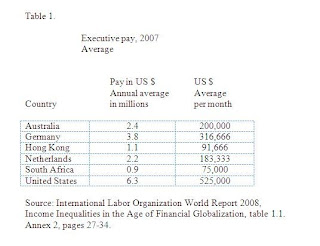
In Australia an executive receive an average of 200,000 US $ of salary per month, but a worker obtain (minimum wage) 1,908 US $ per month; something similar happen in Germany where the average salary of an executive is of 316,666 US $ per month while a worker obtain (minimum wage) 1,701.26 US $.
But the most difference is in the United States, where the monthly of a worker is of 1,209.60 while the executive earning (average) is of 525,000 US $; this mean 434 times more than the former.

Australia pays the higher wages to their workers, followed by France, Germany, the United Kingdom and Italy in the first five places. In this table the United States is in the sixth position regarding the workers earnings, but the United States is in the first place regarding the remuneration of their executives.
Of the selected countries of Asia, Bangladesh has the lesser income followed by Vietnam and China. A person that visited the industrial city of Guangzhou said to me that the workers in that city are practically slaves; they receive a salary of approximately 120 US $ per month and work the thirty (30) days of the month.
Of the selected countries, the communist nations of the past (Russia) and of the present (China and Vietnam) are the societies where the workers receive the lesser wages; in change, in the developed capitalists nations the workers obtain the higher salaries. This reveal the failure of the communism system and it explain why the communism disappeared in the former Soviet Union and in the Eastern Europe.

The situation in Africa is worse than the situation in the poorest nations of Asia.
In Latin America the Dominican Republic has the major wage but that is an exception in the region and in the rest of the underdeveloped nations.
The extreme poverty in Latin America is a sad reality. The case of Brazil and Mexico, which economies are situated between the first ten economies of the world is something that deserves to be considered with special attention: in both countries the minimum wage was less of 100 US $.
Brazil and Mexico have an important industrial development but is evident that their governments have been not able of establishing a fair wage for the workers.
In the most countries of Latin America still exists concentration of the property of the land and a good part of the peasants live in precarious conditions.

Key of the economic expansion
The economic expansion is not possible without just salaries; the politicians and the private entrepreneurs should be aware of this true.
The wages are the force that impulse the market; they are the key factor that determines the effective demand behavior.
A first step for combating the poverty is to increase the wages to a level that let to the workers satisfying its basic necessities.
If the underdeveloped nations do not make an effective effort for improving the wages the poverty will remain and vice verse.
Conclusion
The analysis of the economic reality lead to a conclusion: the most workers in the world are practically slaves because its salaries hardly let them to eat. Only in the developed industrialized nations this does not happen. Nevertheless, the difference between the wages of the executives and the workers earnings in the industrialized countries is something unbelievable: is hundreds of times superior.
It is necessary to carry out a global program for combating the poverty, preserving the natural resources and the environment.
One way are the ecological employments, through a global program of reforestation and conservation of the forests that still survive, as the Amazonia Region. The base of that program should be fair wages for the workers.
This program does not require a great amount of energy for to be developed; in change, other economic activities in the agriculture and the manufacture need a very important amount of energy, oil and coal especially. The world is running out of basic natural resources as water and petroleum. It is a global shortage of resources that change the economic paradigm.
The great problem of the humankind is that the worlds need more food and more manufactured goods, but there is not enough water nor petroleum for sustaining those requirements. In some regions, like China, there is abundance of coal but this is most contaminant source of energy. The other sources as the nuclear energy are too very dangerous, while the industrial eolic and solar energy are not enough developed. So far, the research with hydrogen has been a success, especially in the transport sector, but still it is in the beginning.
The other great problem is that for developing the agriculture the forests are razed and without the forests the live is not possible.
It is necessary a balance between the necessity of producing the essential goods, the use of the natural resources, the creation of jobs and fair wages. Those are great challenges for the creative capacity, especially for the thinkers, scientists, politicians, economists, entrepreneurs and the mass media.
But, what is a just wage?
It is the amount of money for acquiring the goods that a person or a family need for getting welfare.
And what is the welfare?
It is health, food, dress, house, education, recreation, security and stable job; this mean quality of live. The problem is that the most part of the world population do not enjoy of those benefits; the great challenge is changing that situation.
Restrictions of natural resources, especially of water and energy, the scarcity of capital ---know how, technology, goods of capital, infrastructure and money--- do not help to carry out a global and effective program of employments and just wages.
A cause of the poverty
The other great problem is the inequality in the income distribution. The salaries are the basic indicator of the poverty or the well-being of a society.
There is a huge gap between the bosses and executives earnings and the workers salaries.
Only in the developed industrialized nations the workers receive an income for satisfying part of its necessities. In the rest of the world the wages are not enough neither to eat, as it is demonstrated in the following tables.

In Australia an executive receive an average of 200,000 US $ of salary per month, but a worker obtain (minimum wage) 1,908 US $ per month; something similar happen in Germany where the average salary of an executive is of 316,666 US $ per month while a worker obtain (minimum wage) 1,701.26 US $.
But the most difference is in the United States, where the monthly of a worker is of 1,209.60 while the executive earning (average) is of 525,000 US $; this mean 434 times more than the former.

Australia pays the higher wages to their workers, followed by France, Germany, the United Kingdom and Italy in the first five places. In this table the United States is in the sixth position regarding the workers earnings, but the United States is in the first place regarding the remuneration of their executives.
Of the selected countries of Asia, Bangladesh has the lesser income followed by Vietnam and China. A person that visited the industrial city of Guangzhou said to me that the workers in that city are practically slaves; they receive a salary of approximately 120 US $ per month and work the thirty (30) days of the month.
Of the selected countries, the communist nations of the past (Russia) and of the present (China and Vietnam) are the societies where the workers receive the lesser wages; in change, in the developed capitalists nations the workers obtain the higher salaries. This reveal the failure of the communism system and it explain why the communism disappeared in the former Soviet Union and in the Eastern Europe.

The situation in Africa is worse than the situation in the poorest nations of Asia.
In Latin America the Dominican Republic has the major wage but that is an exception in the region and in the rest of the underdeveloped nations.
The extreme poverty in Latin America is a sad reality. The case of Brazil and Mexico, which economies are situated between the first ten economies of the world is something that deserves to be considered with special attention: in both countries the minimum wage was less of 100 US $.
Brazil and Mexico have an important industrial development but is evident that their governments have been not able of establishing a fair wage for the workers.
In the most countries of Latin America still exists concentration of the property of the land and a good part of the peasants live in precarious conditions.

Key of the economic expansion
The economic expansion is not possible without just salaries; the politicians and the private entrepreneurs should be aware of this true.
The wages are the force that impulse the market; they are the key factor that determines the effective demand behavior.
A first step for combating the poverty is to increase the wages to a level that let to the workers satisfying its basic necessities.
If the underdeveloped nations do not make an effective effort for improving the wages the poverty will remain and vice verse.
Conclusion
The analysis of the economic reality lead to a conclusion: the most workers in the world are practically slaves because its salaries hardly let them to eat. Only in the developed industrialized nations this does not happen. Nevertheless, the difference between the wages of the executives and the workers earnings in the industrialized countries is something unbelievable: is hundreds of times superior.
It is necessary to carry out a global program for combating the poverty, preserving the natural resources and the environment.
One way are the ecological employments, through a global program of reforestation and conservation of the forests that still survive, as the Amazonia Region. The base of that program should be fair wages for the workers.
This program does not require a great amount of energy for to be developed; in change, other economic activities in the agriculture and the manufacture need a very important amount of energy, oil and coal especially. The world is running out of basic natural resources as water and petroleum. It is a global shortage of resources that change the economic paradigm.
The great problem of the humankind is that the worlds need more food and more manufactured goods, but there is not enough water nor petroleum for sustaining those requirements. In some regions, like China, there is abundance of coal but this is most contaminant source of energy. The other sources as the nuclear energy are too very dangerous, while the industrial eolic and solar energy are not enough developed. So far, the research with hydrogen has been a success, especially in the transport sector, but still it is in the beginning.
The other great problem is that for developing the agriculture the forests are razed and without the forests the live is not possible.
It is necessary a balance between the necessity of producing the essential goods, the use of the natural resources, the creation of jobs and fair wages. Those are great challenges for the creative capacity, especially for the thinkers, scientists, politicians, economists, entrepreneurs and the mass media.
sábado, 2 de enero de 2010
By lack of water China might increase their cereals imports
Asia -the most populated continent of the world- suffers the consequences of the earth resources overexploitation. A clear example of it is what happens with the underground waters and the China Rivers that irrigate good part of the agricultural lands. Those sources of water present a process of exhaustion that put in danger the agricultural production and might obey at China to increase their imports of food, specifically grains, since might be not able to satisfy their population's demand. This phenomenon already was observed in the Chinese society and was one of the reasons that motivated in 1995 the exports reduction of grains toward North Korea. When China interrupted the sale of grains to North Korea this country didn't have another alternative but requesting international help to the United Nations.
A restitution of the help in foods to North Korea by China seems not very probable since this country continues confronting serious production problems derived of the shortage of the most important inputs for the agricultural production as the water. An example is what happens in the Yellow River that had lost their flow and already doesn't reach the sea. In the year 1996 the River was dry during 133 days while in 1997 remained dry during 226 days. The County of Shandong is the last route of the river before arriving to the sea. This county produces good part of the corn and of the wheat and it has been seriously affected as consequence of the river drought.
What happens with the Yellow River also passes with other important rivers of China and with the more and more scarce underground sources of water. It is considered that China has around of 50,000 kilometers of rivers of certain magnitude and 80% of them are degraded and are not capable for the fishing, due to the contamination that receives. The Yellow River, for example, is polluted of heavy metals and other toxic matters that impede its use for human consumption and irrigation in good part of its route.
The decrease of the China capacity for producing foods will generate an important impact in the world economy, since will look those foods in the international markets causing the increase of its prices. The poor’s countries are not in capacity of resisting an increment in the price of the foods, they would not have how to pay the new prices and, in consequence, they would be in front of a true problem of survival. If the countries with more population as China and India diminish their foods production capacity, the world situation will be aggravated. India, the other giant of the world suffers a similar situation and should use very important part of the energy that produce to pump water of the underground.
World experts estimated that China would have enough water for few years more; this means that would have to import a good parte of their necessities of cereals. If this happen, the impact for the politics and the world economy would be very important.
A restitution of the help in foods to North Korea by China seems not very probable since this country continues confronting serious production problems derived of the shortage of the most important inputs for the agricultural production as the water. An example is what happens in the Yellow River that had lost their flow and already doesn't reach the sea. In the year 1996 the River was dry during 133 days while in 1997 remained dry during 226 days. The County of Shandong is the last route of the river before arriving to the sea. This county produces good part of the corn and of the wheat and it has been seriously affected as consequence of the river drought.
What happens with the Yellow River also passes with other important rivers of China and with the more and more scarce underground sources of water. It is considered that China has around of 50,000 kilometers of rivers of certain magnitude and 80% of them are degraded and are not capable for the fishing, due to the contamination that receives. The Yellow River, for example, is polluted of heavy metals and other toxic matters that impede its use for human consumption and irrigation in good part of its route.
The decrease of the China capacity for producing foods will generate an important impact in the world economy, since will look those foods in the international markets causing the increase of its prices. The poor’s countries are not in capacity of resisting an increment in the price of the foods, they would not have how to pay the new prices and, in consequence, they would be in front of a true problem of survival. If the countries with more population as China and India diminish their foods production capacity, the world situation will be aggravated. India, the other giant of the world suffers a similar situation and should use very important part of the energy that produce to pump water of the underground.
World experts estimated that China would have enough water for few years more; this means that would have to import a good parte of their necessities of cereals. If this happen, the impact for the politics and the world economy would be very important.
lunes, 14 de diciembre de 2009
What the true wealth is? The monetary illusion
Most people think that money is the true wealth. The reason is very simple: because so far you can buy the majority of goods with money.
Too few things you can not acquire with money: the live, health neither true love. The problem is that those are the most important values of the life. You can not avoid the death. The billionaires die the same than the poor’s. There are illnesses that can not be treated with success. The true love is the other vital situation that the money can not buy.
Until now, in the developed nations, you can buy water, food, energy and other material elements if you have money. In the underdeveloped countries is different. There are regions where you can have money but that is not enough for getting the basic goods for live.
The first warning about the natural resources vulnerability was given by the Arab nations in the year 1974, when they decided to impose a petroleum seizure against the United States and Europe, because of the support of those countries to Israel during the Six Days War.
With the exception of that period of time, the developed nations, United States, Japan and the Western nations of Europe has enjoyed of the most natural resources in abundance. Some underdeveloped nations has not had the same luck. The African continent, some regions of Asia, Latin America and Oceania has been affected by the lack of resources, and this provoked the hunger of millions of people in those areas.
An important change in the economics concepts
The traditional economy has assured that oxygen and water are abundant goods; for that reason the first has not had a specific price and the price of the second has been reduced. But that trend started to change and already the oxygen is being appreciated in other dimension and the water price has reached an important increase in many countries.
In the 21st century the perception of the natural resources abundance is changing. Today are scarce the abundant goods of the recent past. Scarce goods are now oxygen, water, food and petroleum; all they are forms of energy. Without those goods the live is not possible. We can say that the modern evolution has affected the quantity and the quality of the energy sources.
The pattern of production and consumption followed until now and the pollution has become abundant resources in scarce resources. Vital goods are running out and this represents a deep change in the economic paradigm.
Wealth and happiness
There is a difference between wealth and happiness. Wealth is material abundance. In change, happiness is knowledge, health, love, employment and material satisfaction. You can be rich but unhappy.
A people or a country may be rich because possesses a great amount of material resources, but unhappy and underdeveloped, because do not have the most important things of the life: knowledge, health nor true love. The development is a combination of these values.
The knowledge is not only privilege of the scientists, the techniques nor the humanists. The modest people have a great knowledge. The farmers, the fishermen, the highlanders have a deep knowledge; they are in touch with nature and that contact give to them a special sensibility and vision of the life. It is the wisdom of the simple things. They know when the time of to sow, to sever and to harvest is. They know the essence of the trees, the behavior of the tides, the weather changes.
The first causes
The most advanced stage of the knowledge is tied to the comprehension of the first causes. Man only discovers the reality of nature. For example, the atomic energy has existed ever; but man discovered and employed it in the 20th century; not before. It is sure that other knowledge’s exists in nature that man still has not discovered but it is very likely that realize it in the future. The comprehension of a part of the true reality of the space and the time, the domain of the illnesses, for example, might be possible in the coming years.
The energy sources use
The Industrial Revolution may be considered as the Revolution of the Energy. Since the beginning of the civilization until the First Industrial Revolution (1769) ---when James Watt created the machine of vapor--- the world used the wood as the principal source of energy. But with the creation of the machine of vapor ---fed by coal--- the situation changed and a new scale of production was developed; this helped to the transformation of the handcraft scale into industrial production, one of the most important advances of the humankind.
The discovery of petroleum in the year 1869 and their later use as new source of energy for the most activities generated a modern scientist and technological development.
Man has overexploited the sources of energy; first he razed the forests for obtaining wood; the whales for getting oil; after it overexploited the coal and the petroleum and in the last decades of the 20th and 21st centuries began again to raze de forests that still survive in the planet.
But the most danger for humanity is the growing employment of atomic energy. In the last decades some nations has appealed to this form of energy because of the restrictions in the availability of other sources as the petroleum and the hydroelectricity. The construction of new atomics plants represents a peril for mankind. The effects of Chernobyl are still present and it constitutes a clear example of the things that human beings must avoid.
Still the science has not been able of creating a massive substitute for the fossil energy; this is one of the major challenges in the world future.
The issue is that none other element has the energetic intensity of the petroleum; for example, the energetic power of a liter of gasoline can not be compared with none other source.
The coal is the other form used in many countries. China has important reserves. The great problem is that coal is the most contaminant element.
Meanwhile, the climatic change, the global warming, is everyday more intense. The glaciers lose the snow worldwide, the oceans level grow and the forests disappear in many regions, specially in the Amazonia, the last natural reserve that still survive in the planet.
That is the reality, a fact linked to a basic conception: that the true wealth is money and other things do not matter. For that reason the countries has not made a real effort for preserving the environment.
The production is oriented to producing money and not to the satisfaction of the human beings necessities. The financial economy is in the first place and the real economy after.
In the year 2008 the bailout was for the financial economy and only a little part for the industry and the citizens that would loose its homes.
If the world does not change this manner of to see the life, the collapse will be unavoidable. In too few time the financial system will fall again; that is a cyclical process derivate of the system nature. The system receives money and spend money for to increase everyday the richness of their owners; very simple.
Monetary illusion
The monetary economy born as consequence of a necessity; the bartering was not able of responding to the increase of the volume of commercial transactions. For that reason, essentially, appeared the monetary economy.
In the money man found a manner of representing the value of the things, in the same form that in the writing he found a way for expressing its thoughts.
But money created a distortion: man think that the accumulation of money constitutes the real wealth of people and nations; and that is a mistake, a great lie.
In the current reality money is only paper and coins without a true value. In the past, when money was developed of gold and silver, the situation was different because the money had a proper value: the value of the gold and silver.
But now money is a simple instrument that let to change that paper or coin by goods or, sometimes, by other currencies more accepted in the market.
The unique base or support of money is the credibility that people have in the money as instrument of change.
So far, the currency for international commerce has been the dollar of the United Sates of America. The majority of the international transactions are realized in this currency. With the born of the Euro a part of those transactions began to be made in the new currency.
Some countries have begun to criticize the use of dollar as instrument of international exchange. In that sense, the news agencies has informed that Iran, Russia and China has considered the use of their national currencies for the petroleum transactions.
This reveals that nothing is definitive. The change is permanent. What will happen in the future? What do you think?
The new economic paradigm
The traditional economy has been supported in the idea of the abundance of natural resources and the scarcity of the resources of capital. But now, in the 21st century the situation is different. Now the scarce factor of production is the natural resources. The signs of water and petroleum shortage already are evident. The impact of these facts on the global production, consumption and the inflation will be more intense.
The value of money will be each day minor as consequence of inflation and the reduction of the natural resources availability. This process will put in evidence that money is really an illusion and that the most important is the knowledge, the environment, the natural resources and the material production.
God bless the world.
Too few things you can not acquire with money: the live, health neither true love. The problem is that those are the most important values of the life. You can not avoid the death. The billionaires die the same than the poor’s. There are illnesses that can not be treated with success. The true love is the other vital situation that the money can not buy.
Until now, in the developed nations, you can buy water, food, energy and other material elements if you have money. In the underdeveloped countries is different. There are regions where you can have money but that is not enough for getting the basic goods for live.
The first warning about the natural resources vulnerability was given by the Arab nations in the year 1974, when they decided to impose a petroleum seizure against the United States and Europe, because of the support of those countries to Israel during the Six Days War.
With the exception of that period of time, the developed nations, United States, Japan and the Western nations of Europe has enjoyed of the most natural resources in abundance. Some underdeveloped nations has not had the same luck. The African continent, some regions of Asia, Latin America and Oceania has been affected by the lack of resources, and this provoked the hunger of millions of people in those areas.
An important change in the economics concepts
The traditional economy has assured that oxygen and water are abundant goods; for that reason the first has not had a specific price and the price of the second has been reduced. But that trend started to change and already the oxygen is being appreciated in other dimension and the water price has reached an important increase in many countries.
In the 21st century the perception of the natural resources abundance is changing. Today are scarce the abundant goods of the recent past. Scarce goods are now oxygen, water, food and petroleum; all they are forms of energy. Without those goods the live is not possible. We can say that the modern evolution has affected the quantity and the quality of the energy sources.
The pattern of production and consumption followed until now and the pollution has become abundant resources in scarce resources. Vital goods are running out and this represents a deep change in the economic paradigm.
Wealth and happiness
There is a difference between wealth and happiness. Wealth is material abundance. In change, happiness is knowledge, health, love, employment and material satisfaction. You can be rich but unhappy.
A people or a country may be rich because possesses a great amount of material resources, but unhappy and underdeveloped, because do not have the most important things of the life: knowledge, health nor true love. The development is a combination of these values.
The knowledge is not only privilege of the scientists, the techniques nor the humanists. The modest people have a great knowledge. The farmers, the fishermen, the highlanders have a deep knowledge; they are in touch with nature and that contact give to them a special sensibility and vision of the life. It is the wisdom of the simple things. They know when the time of to sow, to sever and to harvest is. They know the essence of the trees, the behavior of the tides, the weather changes.
The first causes
The most advanced stage of the knowledge is tied to the comprehension of the first causes. Man only discovers the reality of nature. For example, the atomic energy has existed ever; but man discovered and employed it in the 20th century; not before. It is sure that other knowledge’s exists in nature that man still has not discovered but it is very likely that realize it in the future. The comprehension of a part of the true reality of the space and the time, the domain of the illnesses, for example, might be possible in the coming years.
The energy sources use
The Industrial Revolution may be considered as the Revolution of the Energy. Since the beginning of the civilization until the First Industrial Revolution (1769) ---when James Watt created the machine of vapor--- the world used the wood as the principal source of energy. But with the creation of the machine of vapor ---fed by coal--- the situation changed and a new scale of production was developed; this helped to the transformation of the handcraft scale into industrial production, one of the most important advances of the humankind.
The discovery of petroleum in the year 1869 and their later use as new source of energy for the most activities generated a modern scientist and technological development.
Man has overexploited the sources of energy; first he razed the forests for obtaining wood; the whales for getting oil; after it overexploited the coal and the petroleum and in the last decades of the 20th and 21st centuries began again to raze de forests that still survive in the planet.
But the most danger for humanity is the growing employment of atomic energy. In the last decades some nations has appealed to this form of energy because of the restrictions in the availability of other sources as the petroleum and the hydroelectricity. The construction of new atomics plants represents a peril for mankind. The effects of Chernobyl are still present and it constitutes a clear example of the things that human beings must avoid.
Still the science has not been able of creating a massive substitute for the fossil energy; this is one of the major challenges in the world future.
The issue is that none other element has the energetic intensity of the petroleum; for example, the energetic power of a liter of gasoline can not be compared with none other source.
The coal is the other form used in many countries. China has important reserves. The great problem is that coal is the most contaminant element.
Meanwhile, the climatic change, the global warming, is everyday more intense. The glaciers lose the snow worldwide, the oceans level grow and the forests disappear in many regions, specially in the Amazonia, the last natural reserve that still survive in the planet.
That is the reality, a fact linked to a basic conception: that the true wealth is money and other things do not matter. For that reason the countries has not made a real effort for preserving the environment.
The production is oriented to producing money and not to the satisfaction of the human beings necessities. The financial economy is in the first place and the real economy after.
In the year 2008 the bailout was for the financial economy and only a little part for the industry and the citizens that would loose its homes.
If the world does not change this manner of to see the life, the collapse will be unavoidable. In too few time the financial system will fall again; that is a cyclical process derivate of the system nature. The system receives money and spend money for to increase everyday the richness of their owners; very simple.
Monetary illusion
The monetary economy born as consequence of a necessity; the bartering was not able of responding to the increase of the volume of commercial transactions. For that reason, essentially, appeared the monetary economy.
In the money man found a manner of representing the value of the things, in the same form that in the writing he found a way for expressing its thoughts.
But money created a distortion: man think that the accumulation of money constitutes the real wealth of people and nations; and that is a mistake, a great lie.
In the current reality money is only paper and coins without a true value. In the past, when money was developed of gold and silver, the situation was different because the money had a proper value: the value of the gold and silver.
But now money is a simple instrument that let to change that paper or coin by goods or, sometimes, by other currencies more accepted in the market.
The unique base or support of money is the credibility that people have in the money as instrument of change.
So far, the currency for international commerce has been the dollar of the United Sates of America. The majority of the international transactions are realized in this currency. With the born of the Euro a part of those transactions began to be made in the new currency.
Some countries have begun to criticize the use of dollar as instrument of international exchange. In that sense, the news agencies has informed that Iran, Russia and China has considered the use of their national currencies for the petroleum transactions.
This reveals that nothing is definitive. The change is permanent. What will happen in the future? What do you think?
The new economic paradigm
The traditional economy has been supported in the idea of the abundance of natural resources and the scarcity of the resources of capital. But now, in the 21st century the situation is different. Now the scarce factor of production is the natural resources. The signs of water and petroleum shortage already are evident. The impact of these facts on the global production, consumption and the inflation will be more intense.
The value of money will be each day minor as consequence of inflation and the reduction of the natural resources availability. This process will put in evidence that money is really an illusion and that the most important is the knowledge, the environment, the natural resources and the material production.
God bless the world.
lunes, 7 de diciembre de 2009
The ecological employments, an useful proposal for the Copenhagen’s Summit
The mankind has not options. If this generation does not adopt the measures for preserving the environment in too few years the majority of the world will be a desert. The climate change, the garbage, the destruction of the water sources, the industrial pollution, is a true threat for the present and the future.
In Copenhagen still there is a hope. The development of a Global Program of Ecological Employments, through the reforestation, is an effective road for diminishing the global warming, protecting the nature and to attack the poverty.
Sponsored by the United Nations and the World Bank, and with the cooperation of the governments worldwide, this program might be a hope for millions of people in the entire planet. The decision is in the hands of the leaders that in this moment are in Copenhagen. God bless the world.
In Copenhagen still there is a hope. The development of a Global Program of Ecological Employments, through the reforestation, is an effective road for diminishing the global warming, protecting the nature and to attack the poverty.
Sponsored by the United Nations and the World Bank, and with the cooperation of the governments worldwide, this program might be a hope for millions of people in the entire planet. The decision is in the hands of the leaders that in this moment are in Copenhagen. God bless the world.
jueves, 3 de diciembre de 2009
The natural resources future
In the developed world, North America, Western Europe and Japan, for the majority of the people are not yet perceivable, at first, the signs of a natural resources crisis, but it is a latent process, a developing process that very soon will be felt globally.
An inhabitant of New York, Washington, London or Paris, possibly does not know what not having water for one or two days per week or for a long period of time is. Probably he doesn’t know what electricity restrictions are like; but in other regions of the world these types of limitations are something common or frequent.
Nevertheless, the situation in the developed countries has begun to change and already it exist regions and states in the United States where has been declared the water emergency supply and where also there are problems with the electricity supply.
You, the reader of this essay, perhaps have a doubt and ask yourself if really there is a worldwide crisis of natural resources.
The answer is yes.
Which resources?
There is a crisis of oil, water, food and electricity.
How may be it demonstrated?
The best prove of the natural resources crisis is the price increase of these commodities.
The price of a good reflects its abundance or its scarcity.
In the years 2007 and 2008, the evidence of the natural resources crisis was clearer than in other years:
- The oil price surpassed US$ 90 in October 2007 and two month later, on February Tuesday 19 2008, the West Intermediate Texas reached US $ 100.10 in the New York market; on March Monday 3 the price touched US$ 103.95, passing the barrier of April 1980, that adjusted by inflation was for March 2008 US$ 103.76. The race of prices continued on March 2008 and on Monday 13 the West Texas Intermediate went to US$ 107.
On Friday May 16 2008, the Light Sweet Crude for June delivery reached US $ 126.20 in the New York Market Exchange. In July 2008 reached their maximum level, over $140. As a consequence of the financial crisis and the recession the oil price dropped during the first months of the year 2009 but already has begun to increase over $70 in the last months of the year 2009.
- The wheat price and the price of other cereals reached a record;
- The food price in general grew in an important percentage;
- “Over the past five years, municipal water rates have increased an average of 27% in the United States, 32% in the United Kingdom, 45% in Australia, 50% in South Africa and 58% in Canada.” - (1)
The electricity price registered the same trend; between the year 1990 and the year 2000 the electricity rates in the United States increased in an average of 5.23%but between the year 2000 and 2005 the enhance average was 26.25%, five hundred per cent more. (2)
Until now, first decade of the 21st century, the crisis due to water shortage has been limited to specific regions of Latin America, Africa and Asia and has not had a sufficiently important impact to have the attention of the big world-wide mass media nor of the governments of the developed countries. The same has happened with the oil crises, which only have generated increases in the prices of crude and its derivates but without affecting the availability or the supply of these products, except in the 1973 crisis, when the Arab countries decided to suspend their exports towards the United States and other nations of the West.
We can say then, that in spite of the oil crises which have lifted the prices, the inhabitants of the developed nations have always had abundance of derivatives of petroleum, gasoline, diesel, oil, lubricants and other products and this fact has contributed to create the illusion of the existence of infinite reserves, but this is not true.
But the situation of apparent abundance will change very soon as a result of two facts: the over-exploitation of the natural resources and the contamination. Water will be the most appreciated good and in second place will be petroleum, since these two resources are every day scarcer, as it can be verified when considering the evolution of the contamination processes, deforestation and blighting at world-wide level and analyzing the behavior of the oil reserves. The pollution increased by the emissions of carbon dioxide and other elements that contribute to the global warming, the extinction of numerous species, the contamination of waters of the seas, rivers and lagoons and the nuclear tests, among other elements, constitute a serious threat to life.
The aggression to the environment will have an immediate effect and it will be reflected in the reduction of natural resources availability and also in the diminishment of the food supply. At the same time it will also cause an increase of the conflicts among the countries and within the nations.
The intense fight for the natural resources hence will be the main characteristic of the international policy in the next years to come and this will not only generate important geo strategic and geopolitical changes, but also it will be a determinant factor for the War or the Peace in the 21st Century.
Other important nations, like China and India, the most populated countries in the world, have in front of them the perspective of a great burden due to the water crisis, while the United States, Mexico, the United Kingdom and Norway, among others countries, will see their petroleum reserves reduced drastically.
That, in general, is the international situation in the first decade of the 21st century. The territorial problems related to the problems of shortage of natural resources, constitute the main cause of the conflicts.
(1)Earth Policy Institute, March 7, 2007. “Water Prices Rising Worldwide,” by Edwin H. Clark II http://www.earth-policy.org/updates/2007/updated 64.htm
(2)Energy Information Administration Annual Energy Review 2006 table 8.10 page 257.
An inhabitant of New York, Washington, London or Paris, possibly does not know what not having water for one or two days per week or for a long period of time is. Probably he doesn’t know what electricity restrictions are like; but in other regions of the world these types of limitations are something common or frequent.
Nevertheless, the situation in the developed countries has begun to change and already it exist regions and states in the United States where has been declared the water emergency supply and where also there are problems with the electricity supply.
You, the reader of this essay, perhaps have a doubt and ask yourself if really there is a worldwide crisis of natural resources.
The answer is yes.
Which resources?
There is a crisis of oil, water, food and electricity.
How may be it demonstrated?
The best prove of the natural resources crisis is the price increase of these commodities.
The price of a good reflects its abundance or its scarcity.
In the years 2007 and 2008, the evidence of the natural resources crisis was clearer than in other years:
- The oil price surpassed US$ 90 in October 2007 and two month later, on February Tuesday 19 2008, the West Intermediate Texas reached US $ 100.10 in the New York market; on March Monday 3 the price touched US$ 103.95, passing the barrier of April 1980, that adjusted by inflation was for March 2008 US$ 103.76. The race of prices continued on March 2008 and on Monday 13 the West Texas Intermediate went to US$ 107.
On Friday May 16 2008, the Light Sweet Crude for June delivery reached US $ 126.20 in the New York Market Exchange. In July 2008 reached their maximum level, over $140. As a consequence of the financial crisis and the recession the oil price dropped during the first months of the year 2009 but already has begun to increase over $70 in the last months of the year 2009.
- The wheat price and the price of other cereals reached a record;
- The food price in general grew in an important percentage;
- “Over the past five years, municipal water rates have increased an average of 27% in the United States, 32% in the United Kingdom, 45% in Australia, 50% in South Africa and 58% in Canada.” - (1)
The electricity price registered the same trend; between the year 1990 and the year 2000 the electricity rates in the United States increased in an average of 5.23%but between the year 2000 and 2005 the enhance average was 26.25%, five hundred per cent more. (2)
Until now, first decade of the 21st century, the crisis due to water shortage has been limited to specific regions of Latin America, Africa and Asia and has not had a sufficiently important impact to have the attention of the big world-wide mass media nor of the governments of the developed countries. The same has happened with the oil crises, which only have generated increases in the prices of crude and its derivates but without affecting the availability or the supply of these products, except in the 1973 crisis, when the Arab countries decided to suspend their exports towards the United States and other nations of the West.
We can say then, that in spite of the oil crises which have lifted the prices, the inhabitants of the developed nations have always had abundance of derivatives of petroleum, gasoline, diesel, oil, lubricants and other products and this fact has contributed to create the illusion of the existence of infinite reserves, but this is not true.
But the situation of apparent abundance will change very soon as a result of two facts: the over-exploitation of the natural resources and the contamination. Water will be the most appreciated good and in second place will be petroleum, since these two resources are every day scarcer, as it can be verified when considering the evolution of the contamination processes, deforestation and blighting at world-wide level and analyzing the behavior of the oil reserves. The pollution increased by the emissions of carbon dioxide and other elements that contribute to the global warming, the extinction of numerous species, the contamination of waters of the seas, rivers and lagoons and the nuclear tests, among other elements, constitute a serious threat to life.
The aggression to the environment will have an immediate effect and it will be reflected in the reduction of natural resources availability and also in the diminishment of the food supply. At the same time it will also cause an increase of the conflicts among the countries and within the nations.
The intense fight for the natural resources hence will be the main characteristic of the international policy in the next years to come and this will not only generate important geo strategic and geopolitical changes, but also it will be a determinant factor for the War or the Peace in the 21st Century.
Other important nations, like China and India, the most populated countries in the world, have in front of them the perspective of a great burden due to the water crisis, while the United States, Mexico, the United Kingdom and Norway, among others countries, will see their petroleum reserves reduced drastically.
That, in general, is the international situation in the first decade of the 21st century. The territorial problems related to the problems of shortage of natural resources, constitute the main cause of the conflicts.
(1)Earth Policy Institute, March 7, 2007. “Water Prices Rising Worldwide,” by Edwin H. Clark II http://www.earth-policy.org/updates/2007/updated 64.htm
(2)Energy Information Administration Annual Energy Review 2006 table 8.10 page 257.
Suscribirse a:
Entradas (Atom)


 Entradas


